
| Category | Key Information |
|---|---|
| Global Market Size (2024) | USD 3.1 billion |
| Projected Market (2035) | USD 5.2–5.7 billion |
| Annual Growth Rate (CAGR) | 5.0–6.5% (2025–2035) |
| Small Plant Capacity | 5–30 kg per batch |
| Industrial Plant Capacity | 50–500+ kg per batch |
| Core Equipment Needed | Mixing tanks, dispersers, mills, deaerators, filling machines |
| Production Time (Premium Pans) | Up to 4 months (multiple pours + drying) |
Are you planning to start a watercolor paint business or upgrade your existing production facility? Then, understanding how a production line for watercolor works is absolutely essential. Moreover, the watercolor market is growing faster than ever before, which means now is the perfect time to invest. In this comprehensive guide, we’ll walk you through everything from market opportunities to choosing the right equipment for your needs.
What Is a Watercolor Paint Production Line?
First of all, let’s start with the basics. A production line for watercolor is a complete system that transforms raw materials into finished watercolor paints. Specifically, this system takes pigments, binders, water, and special additives and turns them into the beautiful colors artists love to use.
The Basic Definition
In simple terms, an industrial watercolor production line combines several machines and processes in one coordinated system. Furthermore, this integrated approach ensures that every batch of paint meets the same high-quality standards. The main ingredient that makes watercolor special is gum arabic, which acts as the binder that holds the pigment particles together.
Unlike oil paints or acrylics, watercolors are completely water-based. Therefore, they require different production methods and equipment. The production line must carefully control how the pigments mix with water and gum arabic. Additionally, the system needs to remove air bubbles and ensure smooth, consistent texture in every pan or tube.
Different Forms of Watercolor Products
Interestingly, a single production line for watercolor can create several different product formats. For instance, the same basic paint mixture can be filled into:
- Pans – Small, solid blocks of paint that artists wet with a brush
- Tubes – Moist paint in squeezable containers for larger washes
- Liquid watercolors – Pre-dissolved paints in bottles for education and illustration
- Specialty formats – Sticks, pencils, or markers containing watercolor formulations
Industrial vs. Small-Batch Production
Now, you might wonder how factory production differs from handmade watercolors. Industrial production lines offer several key advantages. First, they can produce hundreds of kilograms per day with consistent quality. Second, automated systems reduce human error and contamination. Third, modern equipment allows for precise color matching across thousands of batches.
However, even in industrial settings, premium watercolor production still requires patience. As one industry expert notes:
“High-quality watercolor pans cannot be rushed. We’ve seen manufacturers use four separate filling steps with controlled drying between each pour. Consequently, this process can take up to four months, but the result is a superior product that artists truly appreciate.”
Therefore, while automation speeds up many steps, the final curing and maturation still demand time. Nonetheless, a well-designed production line for watercolor balances efficiency with the craftsmanship that professional artists expect.
Why Invest in a Watercolor Production Line? Market Growth & Opportunity
Before diving into technical details, let’s examine why watercolor production represents such an exciting business opportunity right now. Indeed, multiple market research firms are reporting impressive growth forecasts for the coming decade.
Explosive Market Growth in Numbers
According to recent market research, the global watercolor industry is experiencing remarkable expansion. Specifically, the market stood at approximately USD 3.1 billion in 2024. However, forecasts predict it will reach between USD 5.2 and 5.7 billion by 2035. That’s nearly double the current size!
| Source / Study Year | 2024–2025 Market Size | 2033–2035 Forecast | Implied CAGR |
|---|---|---|---|
| MRFR Watercolor Report 2025 | USD 3.143 billion (2024) | USD 5.558 billion (2035) | 5.32% (2025–2035) |
| DataInsights Watercolor Pathways | ~USD 1.2 billion (2025) | Projected through 2033 | 6.5% (2025–2033) |
| Accio 2025 Watercolor Trend | ~USD 3.1 billion (2024) | USD 5.2–5.7 billion (2035) | 5.5–6.0% (2024–2035) |
Notably, despite some variation between studies, all analysts agree on one thing: watercolor is a growing niche with steady 5–6% annual growth. Furthermore, this growth rate is considered very healthy for a mature product category.
What’s Driving This Growth?
Several powerful trends are fueling demand for watercolor paints. First and foremost, the hobby art market has exploded, especially since the pandemic. More people are discovering painting as a relaxing, creative outlet. Additionally, online platforms like YouTube and Instagram have made art education more accessible than ever before.
Here are the key growth drivers:
- Hobby boom – Millions of adults are taking up watercolor painting for stress relief and creative expression
- Online tutorials – Free learning resources have removed barriers to entry for beginners
- Education demand – Schools and art programs continue to prefer watercolor for student training
- Premium segment growth – Professional artists are willing to pay more for high-quality, single-pigment colors
- Eco-friendly appeal – Water-based paints attract environmentally conscious consumers
Return on Investment Potential
Consequently, setting up a production line for watercolor offers strong ROI potential. The equipment investment can range from moderate (for small-batch artisan production) to substantial (for high-volume industrial lines). However, watercolor paints command premium pricing, especially in the professional artist segment.
Moreover, once you establish reliable quality and build brand reputation, customer loyalty tends to be very high. Artists often stick with brands they trust for years. Therefore, the recurring revenue potential makes this market particularly attractive for manufacturers.
The 5 Core Stages of Watercolor Manufacturing
Now that you understand the market opportunity, let’s explore exactly how watercolor paint is made. Generally speaking, industrial watercolor production follows five essential stages. Each stage plays a critical role in creating the smooth, vibrant paints that artists depend on.
Stage 1: Pigment Pre-Dispersion
First, the manufacturing process begins with pigment pre-dispersion. At this stage, dry pigment powders are carefully mixed with water and special wetting agents. The goal is to break up clumps and create a smooth slurry.
Importantly, pigments don’t naturally want to mix with water. Therefore, manufacturers add surfactants (wetting agents) that help the water coat each tiny pigment particle. This initial mixing typically happens in stainless steel tanks with gentle agitation. Furthermore, some pigments require longer wetting times than others, so operators must adjust based on the specific color being produced.
Stage 2: High-Shear Dispersion with Binders
Next comes the high-shear dispersion stage, which is absolutely crucial for watercolor quality. At this point, the pre-wetted pigment is combined with gum arabic solution and other binders. Then, powerful mixing equipment applies intense mechanical force to break down pigment clusters.
This is where specialized equipment like a high-speed disperser becomes essential. These machines use rapidly spinning blades to create shear forces that pull apart pigment aggregates. As a result, the paint achieves much better color strength and transparency.
During this stage, manufacturers also add:
- Preservatives to prevent bacterial growth
- Humectants to control drying and re-wetting properties
- pH adjusters to optimize gum arabic performance
- Flow modifiers to improve brushing characteristics
Stage 3: Fine Milling for Ultimate Smoothness
After dispersion, the paint mixture moves to fine milling equipment. This step ensures that every pigment particle is reduced to the optimal size for maximum color intensity and smoothness. Typically, manufacturers use specialized equipment like a three roll mill for this critical operation.
The three roll mill works by passing the paint between three tightly spaced rollers. Each roller spins at a different speed, creating intense shearing action. Consequently, even the most stubborn pigment particles get broken down to microscopic size. Professional artists can immediately tell the difference – well-milled watercolors produce smoother washes with no grittiness.
Stage 4: Vacuum Deaeration
Subsequently, the milled paint must go through deaeration. All that mixing and milling introduces countless tiny air bubbles into the paint. While these bubbles seem harmless, they can actually cause problems. For instance, trapped air can lead to foaming, uneven drying, and poor color density.
Therefore, manufacturers use vacuum deaeration equipment to remove these bubbles. The paint is placed in a sealed chamber, and air pressure is reduced. As the pressure drops, the trapped air bubbles expand and rise to the surface where they pop. This process results in paint with perfect density and consistency.
Stage 5: Maturation, Filling, and Curing
Finally, the paint reaches the filling and curing stage. However, many manufacturers first allow the paint to “mature” in holding tanks for several days. This aging period lets all the ingredients fully integrate and any remaining bubbles dissipate naturally.
For pan watercolors, the filling process is particularly interesting. Premium manufacturers often use multiple pours:
- First pour – A base layer fills roughly 25% of the pan
- First dry – Controlled drying at around 37°C (98°F) for 2–4 weeks
- Second pour – Another layer added on top
- Second dry – Another drying period
- Third and fourth pours – Repeating the process until pans are full
- Final cure – Extended drying and stabilization over several weeks
As a result, the entire process for premium pans can take up to four months. In contrast, tube watercolors can be filled and packaged much faster since they remain moist. Liquid watercolors are even simpler – they’re simply filled into bottles and capped.
Essential Equipment: 6 Machines Every Watercolor Production Line Needs
Moving forward, let’s examine the specific machines required for a professional production line for watercolor. While the exact configuration varies based on production volume and product range, six core machine types form the foundation of every successful operation.
1. Mixing Tanks with Agitators
To begin with, mixing tanks are where the watercolor journey starts. These stainless steel vessels prepare both the pigment slurries and gum arabic solutions. Quality mixing tanks feature:
- Jacketed construction for temperature control (heating or cooling)
- Variable-speed agitators to handle different viscosities
- Smooth, sanitary interior surfaces that prevent contamination
- Proper baffling to ensure thorough mixing without creating excessive vortex
Typically, a watercolor production line will have several mixing tanks of different sizes. For example, one might prepare gum arabic solution while another handles pigment pre-dispersion. This parallel operation significantly improves production efficiency.
2. High-Speed Dispersers
Next, high-speed dispersers are absolutely critical for achieving professional watercolor quality. These powerful machines use a saw-tooth blade spinning at 0–1500 RPM to create intense shear forces.
💡 Equipment Spotlight: Modern dispersers from manufacturers like Z-MIXER TECH offer variable frequency drives (VFDs) that let operators fine-tune speed for each pigment type. Additionally, hydraulic lift systems make it easy to move the disperser between different tanks.
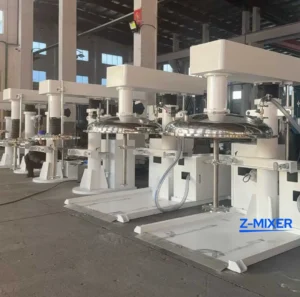
The disperser blade design is particularly important. The teeth must be sharp and properly angled to create maximum turbulence. Furthermore, the blade diameter should match the tank size – too small, and you won’t get complete dispersion; too large, and you’ll waste energy and create excessive heat.
3. Three Roll Mills
Continuing on, the three roll mill represents one of the most specialized pieces of equipment in the production line for watercolor. This machine consists of three horizontally mounted rollers that rotate at different speeds – typically in a ratio of 1:3:9.
Here’s how it works:
- Paint is fed onto the first (feed) roller
- As the rollers rotate, the paint passes through two progressively tighter gaps
- Each gap applies enormous shear force, crushing pigment particles
- The finished paint is scraped off the final (apron) roller
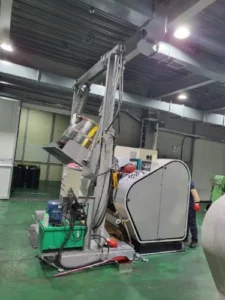
Professional three roll mills can achieve particle sizes below 10 microns. Consequently, the resulting watercolor has exceptional transparency, brilliance, and smoothness. Moreover, modern mills feature precision gap adjustment, typically controlled to within 0.001 inches (25 microns).
4. Vacuum Deaerators
After milling, vacuum deaeration equipment removes trapped air from the paint. These systems typically consist of a stainless steel chamber with a vacuum pump and control system. The paint enters the chamber, vacuum is applied (usually 20–29 inches of mercury), and bubbles are extracted.
Some advanced systems combine deaeration with gentle mixing. This ensures that even as bubbles are removed, the paint remains homogeneous. Additionally, transparent viewing windows let operators visually confirm that all air has been removed before releasing the vacuum.
5. Holding and Maturation Tanks
Once deaerated, the paint needs somewhere to rest and mature. Holding tanks provide this crucial function. These tanks are typically smaller than the main mixing vessels and may include:
- Temperature control to maintain optimal conditions
- Slow agitation to prevent settling without introducing air
- Sampling ports for quality testing
- Transfer pumps to move paint to filling equipment
Importantly, some watercolor formulations benefit from aging for 24–72 hours before filling. During this time, the gum arabic fully hydrates, and minor adjustments to viscosity or color strength can be made.
6. Automatic Filling and Packaging Machines
Finally, filling equipment completes the production line for watercolor. The type of filler depends entirely on your product format:
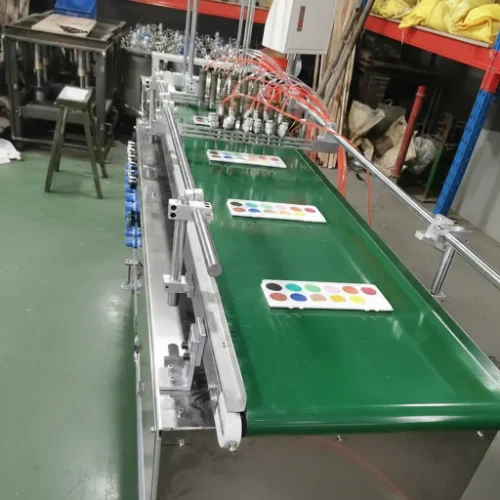
Watercolor Pan Filler
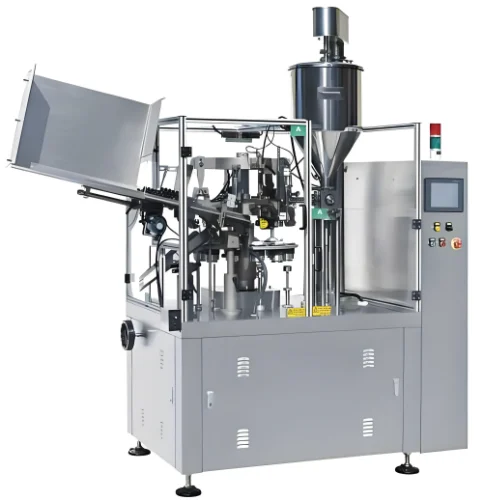
Aluminum Tube Filler
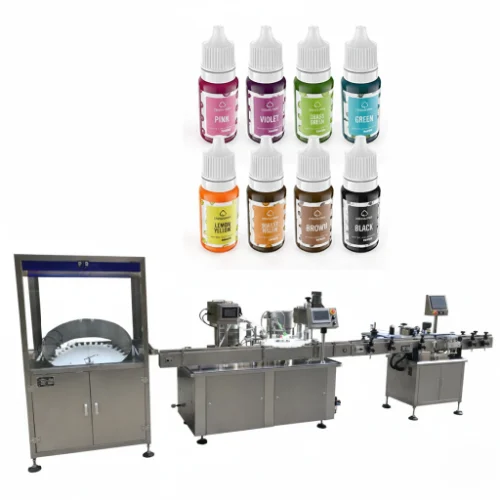
Liquid Bottle Filler
- Pan fillers – Specialized machines that precisely dose paint into small plastic or metal pans
- Tube fillers – Equipment that fills and seals aluminum or plastic tubes
- Bottle fillers – Volumetric or gravimetric systems for liquid watercolors
Modern filling lines offer impressive automation. For instance, they can automatically index pans or tubes into position, fill to precise weight or volume, clean nozzles between colors, and even cap or seal containers. As a result, labor costs drop significantly while consistency improves.
Equipment Comparison at a Glance
| Machine Type | Primary Function | Typical Capacity | Automation Level |
|---|---|---|---|
| Mixing Tanks | Prepare pigment slurries & gum solutions | 50–1,000 liters | Semi to fully automatic |
| High-Speed Dispersers | Break down pigment aggregates | 10–500 kg batches | Manual to automated |
| Three Roll Mills | Fine grinding to micron-level particle size | 5–100 kg/hour throughput | Semi-automatic with digital controls |
| Vacuum Deaerators | Remove trapped air bubbles | 20–200 liters per cycle | Automatic vacuum control |
| Holding Tanks | Storage & maturation before filling | 50–500 liters | Basic automated controls |
| Filling Machines | Precise dosing into pans, tubes, or bottles | 500–5,000 units/hour | Fully automatic with PLC |
Ultimately, choosing the right combination of these six machine types will determine your production capacity, product quality, and operational efficiency. Therefore, working with an experienced equipment supplier like Z-MIXER TECH can help you configure an optimized production line for watercolor that meets your specific needs.
Production Capacity & Plant Layout Planning
After selecting your equipment, the next crucial step involves planning your production capacity and facility layout. Indeed, a well-designed plant layout can dramatically improve efficiency, while a poor layout creates bottlenecks and quality problems.
Understanding Capacity Requirements
First, you need to determine your target production volume. This decision drives everything else – from equipment sizing to building space requirements. Watercolor production facilities generally fall into three categories based on capacity.
| Plant Profile | Typical Batch Size | Annual Output (Estimate) | Notes |
|---|---|---|---|
| Small Studio/Brand | 5–30 kg per batch | 20–100 tons/year | Semi-manual filling; focus on premium/artisan products |
| Medium Industrial | 50–300 kg per batch | 500–3,000 tons/year | Automated dispersers, mills, and filling lines |
| Large OEM/Private Label | 500+ kg per batch | 5,000+ tons/year | High automation; multiple parallel lines; extensive color ranges |
Notably, your capacity planning must account for color changeovers. Unlike producing a single color continuously, watercolor manufacturers typically produce dozens or even hundreds of different colors. Therefore, each batch is smaller, and cleaning between colors takes significant time.
Space Requirements and Layout Zones
Furthermore, a professional production line for watercolor requires careful zoning of your facility. Industry experts recommend dividing the plant into distinct areas to prevent cross-contamination and optimize workflow. Here’s a typical layout structure:
- Raw material receiving and storage – Climate-controlled area for pigments, gum arabic, and chemicals (150–300 sq ft for small plants)
- Pigment slurry preparation – Dedicated mixing area with dust collection for dry pigment handling (200–400 sq ft)
- Gum solution preparation – Separate zone for dissolving gum arabic and preparing binder solutions (100–200 sq ft)
- Main dispersion and milling – Central production area with dispersers and mills (400–800 sq ft)
- Deaeration and holding – Finishing area before filling (150–300 sq ft)
- Filling and packaging – Clean room or controlled environment for filling operations (300–600 sq ft)
- Drying and curing – Temperature-controlled rooms for pan drying (500–2,000 sq ft depending on volume)
- Quality control lab – Testing area with colorimeters and application testing facilities (150–300 sq ft)
- Finished goods storage – Climate-controlled warehouse space (300–1,000+ sq ft)
As a result, even a modest watercolor facility requires at least 2,500–4,000 square feet of production space, plus offices and employee facilities. Larger industrial operations may need 10,000–20,000+ square feet to accommodate multiple production lines and extensive drying capacity.
Workflow Optimization Strategies
Moreover, the physical arrangement of equipment dramatically affects productivity. The most efficient layouts follow a logical flow from raw materials to finished goods without backtracking. Consider these best practices:
- Gravity flow where possible – Position tanks and equipment so paint can flow downward, reducing pumping needs
- Minimize transfer distances – Place dispersers near mills, mills near deaerators, etc.
- Parallel processing capability – Design the layout so multiple colors can be in production simultaneously at different stages
- Dedicated cleaning stations – Provide convenient wash-down areas near all major equipment
- Clear pathways – Ensure forklifts or pallet jacks can easily move materials without interfering with production
Consequently, many manufacturers choose a U-shaped or linear layout that moves materials efficiently from one end of the facility to the other. Additionally, keeping the filling/packaging area separate (often with positive air pressure and air filtration) helps maintain product cleanliness.
Scalability Considerations
Finally, think about future growth when planning your layout. A smart approach is to design the facility with expansion in mind. For example, you might install plumbing, electrical, and HVAC infrastructure for two production lines but initially equip only one. Later, when demand grows, you can add the second line with minimal disruption and cost.
Similarly, modular equipment offers flexibility. Instead of one massive 1,000-liter mixing tank, consider two 500-liter tanks. This configuration allows you to produce two different colors simultaneously and provides redundancy if one unit needs maintenance.
Quality Control: Ensuring Color Consistency in Every Batch
Without question, quality control represents the heart of successful watercolor manufacturing. Artists are incredibly sensitive to color variation – even a slight shift can ruin their work. Therefore, implementing rigorous QC procedures is non-negotiable for any production line for watercolor.
Critical Quality Parameters to Monitor
First and foremost, let’s identify what actually needs to be measured. Watercolor quality isn’t just about color; it also involves texture, flow properties, and long-term stability. Here are the key parameters that professional manufacturers test for every batch:
- Color accuracy (ΔE) – Spectrophotometric measurement comparing the batch to the standard color
- Tinting strength – How much pigment power the paint delivers in washes
- Viscosity and rheology – How the paint flows and behaves during application
- Fineness of grind – Particle size measured with a grind gauge (typically 10–25 microns for watercolor)
- Pigment concentration – Dry film density and solid content
- Re-wetting properties – How easily dried paint dissolves again (crucial for pans)
- pH level – Affects gum arabic stability and preservative effectiveness (typically 7–8.5)
- Lightfastness rating – Long-term color stability under UV exposure
Color Measurement and Matching
Modern watercolor production relies heavily on spectrophotometry for color control. These instruments measure the exact wavelengths of light reflected by the paint, creating a “color fingerprint.” Then, computer software compares this fingerprint to the master standard and calculates the ΔE (Delta E) value – a number representing how different two colors appear.
In the watercolor industry, most manufacturers aim for ΔE values below 1.0 for professional-grade colors. Values between 1.0–2.0 might be acceptable for student grades, while anything above 2.0 is typically considered off-spec and requires adjustment or rejection.
“Color matching in watercolor is particularly challenging because the paint appears differently when wet versus dry, and also varies dramatically depending on dilution. Therefore, we’ve developed a standardized testing protocol that measures color at three dilutions on specific watercolor paper. Only when all three measurements pass do we approve the batch.”
– Senior QC Manager, European watercolor manufacturer
Physical Testing Procedures
Beyond color, physical testing ensures the paint performs correctly. For instance, fineness of grind testing uses a specialized gauge with graduated grooves. Paint is spread across the gauge with a scraper, and the operator notes where pigment particles start to appear. This indicates the maximum particle size present in the batch.
Additionally, viscosity testing helps ensure consistent flow properties. While watercolor isn’t as viscosity-sensitive as wall paint, tube watercolors must have enough body to stay in the tube but still flow smoothly onto the palette. Rotational viscometers or simple flow cups can monitor this parameter effectively.
Application and Performance Testing
Furthermore, no amount of laboratory testing can replace real-world performance evaluation. Consequently, quality watercolor manufacturers conduct application testing with every batch. This typically involves:
- Drawdown tests – Paint is applied to standard watercolor paper in graduated washes
- Masstone evaluation – Full-strength color is observed and compared to standards
- Tint evaluation – Paint is diluted to various ratios and assessed for transparency and color shift
- Drying time observation – How long the paint takes to dry at controlled humidity
- Re-wetting test – For pans, how easily the dried paint activates with a wet brush
- Staining vs. lifting properties – Whether the paint can be lifted from paper or stains permanently
These tests must be conducted by trained evaluators in standardized lighting conditions (typically D65 daylight simulation at 5000K). Interestingly, many manufacturers maintain a panel of testers because color perception varies slightly between individuals.
Documentation and Traceability
Finally, comprehensive documentation ties everything together. Every batch of paint should have a record including:
- Batch number and production date
- Raw material lot numbers (pigments, gum arabic, additives)
- Equipment used and operator names
- All QC test results with pass/fail decisions
- Any adjustments made to bring the batch into specification
- Final approval signature and release to packaging
This traceability becomes critical if quality issues arise later. With complete records, manufacturers can quickly identify which batches might be affected and whether the problem originated with raw materials, process variations, or equipment issues.
Automation & Smart Controls for Modern Watercolor Lines
Increasingly, automation is transforming the watercolor industry from a craft-based operation into a precision manufacturing process. Modern production lines for watercolor now incorporate sophisticated control systems that improve consistency, reduce waste, and lower labor costs.
PLC-Based Process Control
At the heart of modern automation lies the programmable logic controller (PLC). These industrial computers orchestrate the entire production sequence with precision timing. For example, a PLC can automatically:
- Control the sequence of adding raw materials to mixing tanks
- Adjust agitator speeds based on viscosity sensors
- Monitor temperatures and activate heating or cooling as needed
- Time dispersion cycles to ensure adequate processing
- Coordinate material transfers between equipment
- Trigger alarms if any parameter goes out of acceptable range
Moreover, PLC systems offer enormous flexibility. When you need to produce a different color, you simply load a different recipe. The system then executes that recipe exactly the same way every time, eliminating the variations that come with manual operation.
Automated Ingredient Dosing
Another major advancement is automated dosing of raw materials. Instead of operators weighing out pigments and additives manually, modern systems use gravimetric or volumetric feeders. These devices measure and dispense exact quantities directly into the mixing tank.
The benefits are substantial. First, dosing accuracy improves dramatically – often to ±0.1% or better. Second, operators are protected from dust exposure when handling dry pigments. Third, the system creates an automatic record of exactly what went into each batch, improving traceability.
Furthermore, some advanced installations use “minor ingredient systems” that automatically dose small quantities of additives, preservatives, and flow modifiers. These systems are particularly valuable because small ingredients are easy to forget or mis-measure manually, yet they significantly impact paint performance.
Recipe Management Systems
In addition, sophisticated recipe management software helps manufacturers maintain hundreds of color formulations. These systems store not just the ingredient lists but also the complete processing instructions:
- Which equipment to use for each step
- Mix speeds and durations
- Temperature setpoints
- Transfer sequences
- QC checkpoints and specifications
- Even notes about special handling requirements for difficult pigments
Consequently, when an operator starts a new batch, they select the color from the system, and the software guides them through every step. This reduces training time for new employees and ensures that knowledge doesn’t depend on a single experienced person.
Real-Time Monitoring and Data Logging
Additionally, modern control systems continuously monitor and log process data. Sensors track dozens of parameters throughout production – temperatures, pressures, flow rates, motor currents, and more. This data gets automatically recorded with timestamps.
Later, if a quality issue emerges, manufacturers can review the data logs to identify what went wrong. For instance, if a batch has unusual viscosity, reviewing the dispersion time and speed might reveal that the disperser stopped prematurely due to a brief power interruption.
“Since implementing our automated control system, our batch-to-batch color consistency improved by over 40%. Even more importantly, we can now trace exactly what happened during production of every single batch we’ve made in the past three years. This data has been invaluable for continuous improvement and troubleshooting.”
– Production Manager, North American watercolor manufacturer
Variable Frequency Drives (VFDs)
Meanwhile, variable frequency drives have revolutionized mixing and dispersion equipment. A VFD controls the speed of electric motors with extreme precision. Instead of running at a fixed RPM, equipment can ramp up slowly, hold at specific speeds, and ramp down gently.
This capability matters tremendously for watercolor production. Different pigments require different dispersion speeds – for example, organic pigments often need gentler treatment than mineral pigments to avoid damage. With VFDs on dispersers, operators can dial in the perfect speed for each color, then save those settings in the recipe.
Integration with Filling and Packaging
Finally, the most advanced production lines for watercolor integrate the entire process from mixing through filling. When a batch is approved by QC, the system automatically transfers the paint to the appropriate filling station. The filling machine reads the batch number, retrieves the correct filling parameters, and begins operation.
Some systems even track individual pans or tubes with serialized labels or RFID tags. This allows complete traceability down to the individual unit level – particularly important for premium products and export markets with strict documentation requirements.
Safety, Environmental & Regulatory Standards
Naturally, operating a production line for watercolor involves various safety, environmental, and regulatory considerations. While watercolor is generally among the safest paint types to manufacture (being water-based), responsible manufacturers still take these obligations seriously.
Worker Safety and Industrial Hygiene
First and foremost, protecting workers must be the top priority. The main hazards in watercolor production include:
- Pigment dust exposure – Many pigments can irritate lungs if inhaled as dust
- Repetitive motion injuries – From manual filling or packaging operations
- Chemical exposure – Preservatives and other additives require proper handling
- Machinery hazards – Moving parts on mixers, mills, and other equipment
- Slip and fall risks – From spilled liquids in production areas
Therefore, proper safety programs should include dust collection systems at pigment handling stations, personal protective equipment (respirators, gloves, safety glasses), machine guarding on all rotating equipment, and non-slip flooring in wet areas. Additionally, comprehensive safety training ensures all employees understand the hazards and how to work safely.
Environmental Considerations
Furthermore, watercolor manufacturing has a significantly smaller environmental footprint compared to solvent-based coatings. Nevertheless, several environmental aspects require management:
- Wastewater management – Equipment cleaning generates water containing pigments and gum arabic
- Air emissions – Dust collection systems need proper filters; minimal VOCs but some drying processes release water vapor
- Solid waste – Off-spec paint, empty raw material containers, and dried paint residues
- Energy consumption – Heating for drying operations and equipment motors
Increasingly, manufacturers are adopting sustainable practices. For example, some facilities reclaim and reuse wash water, while others have implemented heat recovery systems to capture warmth from drying ovens. Additionally, eco-friendly packaging (recyclable plastics, FSC-certified cardboard) appeals to environmentally conscious consumers.
Regulatory Compliance Requirements
Moreover, watercolor manufacturers must navigate various regulatory requirements depending on their location and target markets. Common regulations include:
- Product safety standards – ASTM D-4236 in the USA requires evaluation and labeling of art materials for chronic health hazards
- Heavy metal restrictions – Limits on lead, cadmium, and other metals, especially for products marketed to children
- Labeling requirements – Ingredient disclosure, hazard warnings, and conformity marks (CE in Europe, etc.)
- Manufacturing licenses – Local permits for operating production facilities
- Environmental permits – Wastewater discharge, air emissions, and waste disposal authorizations
Importantly, regulations vary significantly by country and region. Products exported to Europe must comply with REACH chemical registration, while exports to California require Proposition 65 considerations. Therefore, working with regulatory consultants or industry associations helps manufacturers stay compliant.
Quality Management Systems
In addition, many professional watercolor manufacturers implement formal quality management systems like ISO 9001. These systems provide a structured framework for:
- Documenting processes and procedures
- Training and competency management
- Calibration and maintenance of equipment
- Supplier qualification and raw material control
- Corrective and preventive action programs
- Customer complaint handling
- Continuous improvement initiatives
While ISO certification isn’t legally required, it demonstrates commitment to quality and provides a competitive advantage when supplying major retailers or OEM customers.
Safety Checklist for Watercolor Manufacturing
To help you get started, here’s a practical safety and compliance checklist:
✓ Worker Safety:
- Dust collection systems installed and functioning
- PPE provided and training completed
- Machine guards in place on all equipment
- Emergency eyewash stations accessible
- Safety data sheets (SDS) available for all chemicals
✓ Environmental:
- Wastewater treatment or proper disposal arranged
- Waste segregation program implemented
- Spill response kits and procedures in place
✓ Regulatory:
- Product formulations reviewed for restricted substances
- Toxicological evaluations completed (ASTM D-4236 or equivalent)
- Labeling reviewed for compliance with target markets
- Required permits and licenses obtained
✓ Quality:
- QC procedures documented and followed
- Batch records maintained for traceability
- Calibration schedule established for test equipment
By systematically addressing these areas, you’ll create a safe, compliant, and sustainable operation that protects workers, the environment, and your business reputation.
How to Choose Your Watercolor Production Line Supplier: 7-Point Checklist
Ultimately, selecting the right equipment supplier may be the most important decision you make when establishing your production line for watercolor. The right partner brings not just machinery but also expertise, support, and long-term reliability. Here’s a systematic approach to evaluating potential suppliers.
1. Industry Experience and Specialization
First, assess the supplier’s experience specifically with water-based paint systems. While many companies offer mixing equipment, not all understand the unique challenges of watercolor production – such as working with gum arabic, achieving extremely fine particle sizes, and preventing air entrapment.
Look for suppliers who can demonstrate:
- Previous installations in paint, coating, or ink industries
- Understanding of watercolor-specific requirements
- Technical publications or case studies showing their expertise
- References from other watercolor or artist paint manufacturers
For example, Z-MIXER TECH specializes in paint production equipment including planetary mixers, high-speed dispersers, and three roll mills – all critical components for watercolor manufacturing.
2. Comprehensive System Design Capability
Next, determine whether the supplier can design a complete, integrated system rather than just selling individual machines. A good supplier will:
- Ask detailed questions about your products, volumes, and future plans
- Provide layout drawings showing equipment placement and workflow
- Specify all auxiliary components (pumps, piping, controls, etc.)
- Identify potential bottlenecks and suggest solutions
- Offer alternatives at different price points and automation levels
Moreover, the best suppliers think beyond just equipment. They consider how your entire operation will function, including material handling, cleaning procedures, maintenance access, and expansion possibilities.
3. Equipment Quality and Construction Standards
Third, carefully evaluate the quality of the equipment itself. Since watercolor production involves direct food-grade or cosmetic-grade materials, construction quality is paramount. Key factors include:
- Materials of construction – 304 or 316 stainless steel for all product-contact surfaces
- Surface finishes – Polished, sanitary welds without crevices where paint can hide
- Seals and gaskets – FDA-approved materials that won’t contaminate paint
- Motors and drives – Industrial-grade components from reputable manufacturers
- Controls – UL or CE certified electrical panels with proper safety interlocks
Don’t hesitate to request specifications, material certifications, and even factory visits to inspect equipment before purchase. Reputable suppliers welcome this scrutiny.
4. Customization and Flexibility
Furthermore, consider how well the supplier can adapt their standard offerings to your specific needs. Watercolor production often requires customization – for example, special tank sizes to handle low-volume colors, or modified filling equipment for unusual container shapes.
A flexible supplier will:
- Offer standard models as starting points but customize as needed
- Provide engineering resources to develop special solutions
- Be willing to integrate equipment from other vendors if necessary
- Design systems that can accommodate future product variations
5. Installation, Training, and Commissioning Support
Fifth on the checklist is post-sale support. Even the best equipment is worthless if it’s not properly installed and your team doesn’t know how to operate it. Therefore, verify what support the supplier provides:
- Installation services – Do they send technicians to set up and test equipment?
- Operator training – How many days of training are included, and where does it happen?
- Commissioning support – Will they help you make your first successful batches?
- Documentation – Do you receive complete manuals, wiring diagrams, and spare parts lists?
- Recipe development – Some suppliers offer formulation support to help you optimize your products
Ideally, the supplier’s technician should remain on-site until you’re producing acceptable product consistently. This hands-on support during startup prevents months of frustrating trial-and-error.
6. Long-Term Service and Spare Parts Availability
Sixth, investigate the supplier’s long-term service capability. Production equipment should last 15–20 years or more with proper maintenance. During that time, you’ll need spare parts, occasional troubleshooting help, and perhaps upgrades or modifications.
Evaluate:
- Spare parts inventory and delivery times
- Availability of service technicians (local vs. overseas)
- Technical support responsiveness (phone, email, video calls)
- Preventive maintenance programs or service contracts
- Upgrade paths as technology advances
Suppliers with local representation or service networks obviously provide faster support than those requiring international travel for every service call.
7. Price, Payment Terms, and Overall Value
Finally, consider the total cost of ownership, not just the purchase price. While everyone has budget constraints, the cheapest option rarely provides the best value. Instead, evaluate:
- Initial equipment cost – Is it competitive for the capabilities provided?
- Payment terms – Deposits, progress payments, and final payment timing
- Warranty coverage – Length and what’s actually covered
- Energy efficiency – Operating costs over the equipment’s lifetime
- Reliability and downtime – Well-built equipment has lower maintenance costs
- Productivity – Faster, more automated equipment can justify higher initial cost
“When we first started, we bought the least expensive equipment we could find. Within two years, we were replacing it because it couldn’t maintain the consistency our customers demanded. The second time, we invested in quality equipment from an experienced supplier. That decision paid for itself in reduced waste and higher customer satisfaction within 18 months.”
– Founder, boutique watercolor brand
Your Supplier Selection Decision
In summary, choosing a production line for watercolor supplier is a partnership decision, not just a purchasing transaction. The ideal supplier combines:
- Deep understanding of paint manufacturing processes
- Ability to design complete, optimized systems
- High-quality, sanitary equipment construction
- Flexibility to customize for your needs
- Comprehensive installation and training support
- Reliable long-term service and parts availability
- Fair pricing with excellent total value
By systematically evaluating potential suppliers against these seven criteria, you’ll make a confident, informed decision that sets your watercolor business up for long-term success.
Frequently Asked Questions (FAQ)
How is watercolor paint manufactured on an industrial scale?
Industrial watercolor manufacturing starts by grinding pigments to fine particles and dispersing them into water with gum arabic binders. Then, wetting agents and preservatives are added. The mixture goes through fine milling (often using three-roll mills) to achieve smooth texture. Next, vacuum deaeration removes trapped air bubbles. Finally, the paint is tested, filled into pans, tubes, or bottles, and cured. Premium poured pans may undergo multiple fills with weeks or months of controlled drying between pours to achieve maximum pigment concentration.
What equipment is needed to make watercolor paint?
A complete production line for watercolor typically requires: mixing tanks with agitators for preparing slurries, high-speed dispersers for breaking down pigment clusters, fine mills (such as three roll mills) for achieving smooth texture, vacuum deaeration units to remove air, storage tanks for maturation, and filling/packaging machines. Smaller operations might use benchtop mixers and manual filling, while large industrial plants rely on fully automatic systems with integrated dosing and PLC control.
What is the market outlook for watercolor paints?
Market research projects strong growth for watercolor paints over the next decade. The global market is expected to grow from approximately USD 3. 1 billion in 2024 to USD 5.2–5.7 billion by 2035, representing a compound annual growth rate (CAGR) of 5–6. 5%. Growth drivers include increasing hobby painting participation, widespread online art tutorials, expanded use in education, demand for premium artist-grade products, and the eco-friendly appeal of water-based formulations.
How long does it take to produce watercolor pans?
Production time varies dramatically based on quality tier. For high-end poured pans, premium manufacturers use a process involving four separate filling steps into pans, with each pour followed by controlled drying at approximately 37°C (98°F) for several weeks. This complete process can take up to four months from first pour to finished, packaged pan. Faster processes exist for student and mass-market ranges, but extended drying improves pigment concentration, pan durability, and re-wetting performance for professional-grade products.
What is the difference between student and artist-grade watercolor production?
Both grades use similar production equipment and steps, but artist-grade watercolors generally use higher pigment loads (more color, less filler), expensive single-pigment formulations rather than color blends, and longer milling times to achieve maximum smoothness. Additionally, artist grades receive more extensive drying and curing to ensure superior lightfastness and intensity. Student ranges typically use more economical multi-pigment blends and higher extender levels to reduce cost, but still follow proper industrial standards for dispersion, milling, and quality control to ensure consistent classroom performance.
Can one production line make both watercolor and other water-based paints?
Yes, many water-based paint production lines can be adapted to manufacture watercolor along with other low-viscosity coatings such as acrylic paints, gouache, or craft paints. However, this requires careful attention to equipment materials, thorough cleaning procedures between product types, and strict contamination controls. Using flexible mixing equipment like planetary mixers and modular systems allows plants to switch between emulsion paint, craft paints, and watercolor batches with appropriate cleaning and validation steps between runs.
Conclusion: Your Roadmap to Watercolor Manufacturing Success
As we’ve explored throughout this comprehensive guide, establishing a successful production line for watercolor requires careful planning, the right equipment, and a commitment to quality. The opportunity is clear – with the global watercolor market projected to nearly double by 2035, now is an excellent time to enter or expand in this growing industry.
Key Takeaways for Your Watercolor Production Journey
Let’s recap the essential elements that will determine your success:
- Market opportunity is strong – 5–6.5% annual growth driven by hobby artists, online education, and premium product demand
- Process knowledge is critical – Understanding the five core stages from pigment dispersion through curing ensures consistent quality
- Equipment selection matters – Investing in quality mixing tanks, dispersers, mills, and filling equipment pays long-term dividends
- Layout optimization improves efficiency – Proper facility design prevents bottlenecks and supports future growth
- Quality control is non-negotiable – Artists demand consistency, so rigorous testing and documentation are essential
- Automation delivers ROI – Modern control systems improve consistency while reducing labor costs and waste
- Supplier partnership is key – Choose an experienced equipment partner who understands paint manufacturing
Taking the Next Step
Whether you’re just starting to explore watercolor production or ready to upgrade your existing facility, the path forward becomes clearer with expert guidance. At Z-MIXER TECH, we specialize in helping paint manufacturers like you design and implement optimized production systems.
Our experience with high-speed dispersers, three roll mills, planetary mixers, and complete paint production lines means we understand the unique challenges of watercolor manufacturing. From initial concept through installation, training, and ongoing support, we’re committed to your success.
Ready to Start Your Watercolor Production Line?
Don’t navigate this complex decision alone. Our team of technical experts is ready to help you:
- Evaluate your specific production requirements and goals
- Design a customized equipment configuration that fits your budget
- Provide detailed specifications and layout recommendations
- Offer competitive pricing with transparent payment terms
- Support you through installation, commissioning, and beyond
Contact Z-MIXER TECH today for a free consultation about your watercolor production line project. Let’s turn your vision into reality.
Get Your Custom Production Line Quote
Speak with our watercolor equipment specialists and receive a tailored solution for your business.
📧 Email: [viki@z-mixer.com] | 📞 Phone: [+86 19851090655]
The watercolor market is growing, and the time to act is now. With the right equipment, expertise, and partner, your watercolor production line can deliver the quality products that artists around the world are eager to buy. Let’s build your success story together.
Additional Resources & Industry References
To further support your watercolor production line planning and stay updated on industry trends, we recommend exploring these authoritative external resources:
Market Research & Industry Analysis
- Market Research Future – Global Watercolor Market Report – Comprehensive market size forecasts and growth analysis through 2035
- Grand View Research – Paints & Coatings Industry Analysis – Broader paint industry trends and statistics
- Allied Market Research – Art Materials Market – Analysis of the global art supplies sector
Technical Standards & Safety Resources
- ASTM D-4236 Standard Practice – Safety labeling requirements for art materials in the United States
- European Chemicals Agency (ECHA) – REACH Regulations – Chemical compliance for European markets
- ISO 9001 Quality Management Standards – International quality management system framework
Paint Manufacturing & Technology Resources
- American Coatings Association – Industry association providing technical resources and regulatory guidance
- PCI Magazine (Paint & Coatings Industry) – News, technology updates, and formulation insights
- European Coatings Journal – Technical articles on coatings production and innovation
Equipment & Process Engineering
- Chemical Engineering Magazine – Process equipment selection and optimization strategies
- Powder & Bulk Solids – Guidance on pigment handling and dispersion systems
Color Science & Measurement
- X-Rite Color Education – Color measurement fundamentals and Delta E explained
- HunterLab Color Measurement Resources – Technical guides on spectrophotometry and color matching
Note: External links are provided for educational purposes. Z-MIXER TECH does not endorse or control the content of external websites. Please verify all information independently for your specific application.