
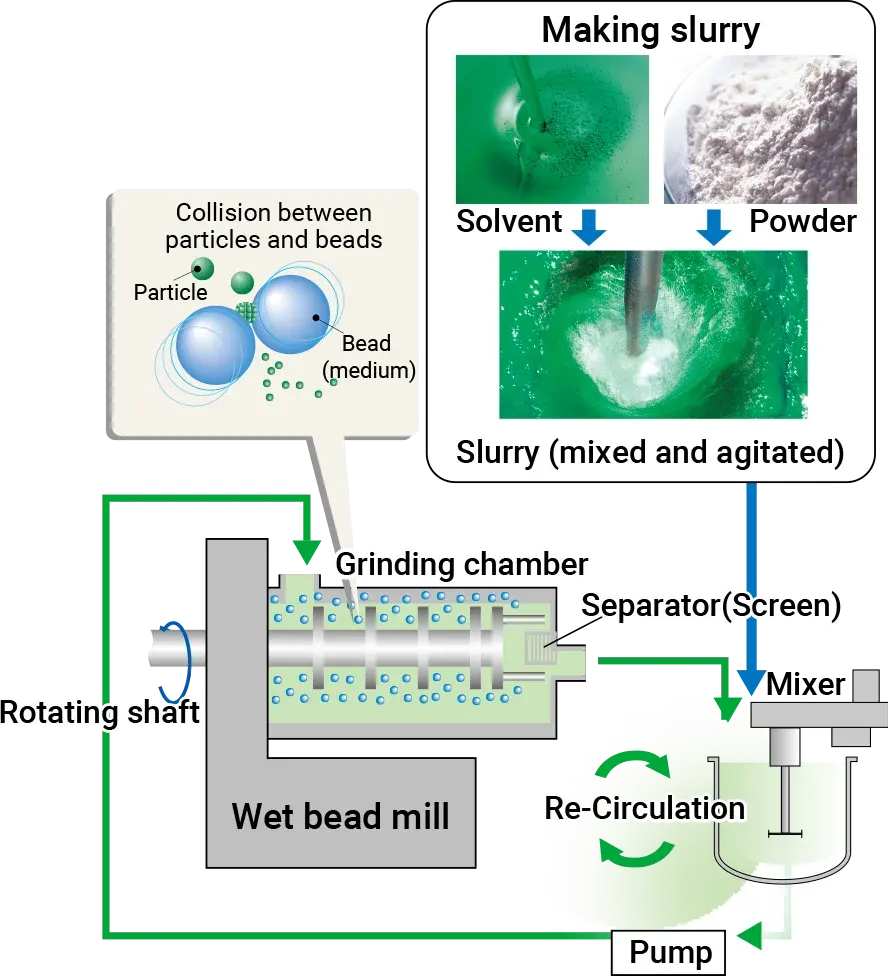
A disc agitator bead mill spins flat discs that push the liquid, and the liquid then drags the beads. A pin agitator bead mill spins hardened pins that hit the beads directly. As a result, disc mills are simple and cost-effective for coarser grinding, while pin mills reach finer sizes with a tighter size range.
Pin vs Disc Agitator Bead Mills at a Glance
| Feature | Disc agitator bead mill | Pin agitator bead mill |
|---|---|---|
| How energy reaches the beads | Viscous drag: discs move the fluid, and the fluid moves the beads | Direct impact: pins strike the beads |
| Typical bead size (vendor ranges) | 0.8-2.0 mm; about 0.6 mm and above for most separators | 0.1-1.0 mm; 0.3-1.0 mm is standard |
| Typical tip speed (vendor ranges) | 8-14 m/s | 10-16 m/s |
| Chamber shape | Long and narrow (L/D about 3:1) | Short and wide (L/D about 1.5:1) |
| Typical fineness | About 5-10 µm; minimum about 1 µm | Below 5 µm; down to about 200 nm |
| Particle size range | Moderate spread | Very narrow spread |
| Heat at standard fineness | Lower | Higher; needs stronger cooling |
| Cost | Lower purchase and upkeep cost | Higher purchase cost; harder wear parts |
| Best for | Architectural paint, standard inks | Inkjet, automotive, battery, nano products |
Choosing between a pin agitator and a disc agitator is one of the biggest decisions when you buy a bead mill. The rotor sets how much energy the beads get, how small your beads can be, and how fine your product becomes. In addition, it affects heat, upkeep and price. So, a wrong choice can cost you years of extra power and lost quality.
This guide explains the real difference in plain English. First, you will see how each rotor works. Next, you will compare them side by side on size, speed, beads, heat, cost and energy. Then, you will use a simple checklist to pick the right one. We also point out which numbers come from engineering research and which come from supplier brochures.
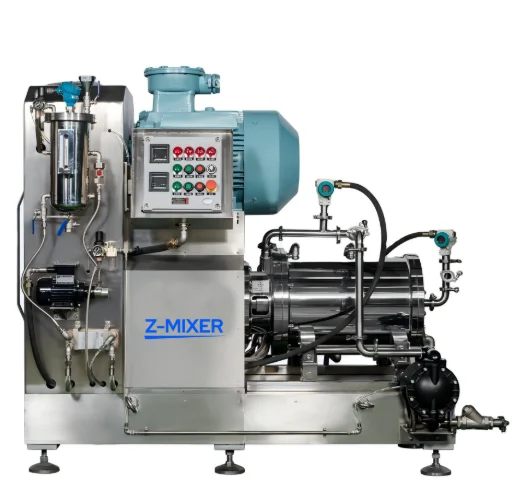
We are Z-MIXER TECH, a maker of horizontal bead mills since 2008. Our range includes disc, pin, turbine and nano designs, so we have no reason to push only one type. If you want a broader market view first, read our sand mill manufacturer guide, and then come back here for the rotor details.
Why Rotor Geometry Is the Biggest Decision in Bead Mill Selection
Once you know your chamber size and separator, the rotor is the next big choice. It decides how much energy goes into each cubic centimeter of the chamber. Because of this, it also decides the smallest bead you can use and the finest product you can make.
The Rotor Sets the Rules
Think of the rotor as the engine room of the grinding process. The chamber holds the beads, and the separator keeps them in. However, the rotor is the part that makes the beads move and hit the particles. So, two mills with the same chamber size can give very different results if their rotors differ.
Same Horsepower, Very Different Results
A classic example comes from an engineering paper in JCT CoatingsTech by H. W. Way (January 2004). It notes that a 20 L disc mill has about 25 to 30 hp. It also notes that a 10 L pin mill has about the same 25 to 30 hp. In other words, the pin mill puts the same power into half the volume. As a result, it packs far more energy into each liter of chamber.
The CoatingsTech paper makes this point clearly. Machines with the same power can behave very differently, because the pin mill puts that power into a much smaller volume, which gives it a much higher energy density.
Paraphrased from H. W. Way, “Grinding and Dispersing Nanoparticles,” JCT CoatingsTech, January 2004.
What the Rotor Controls
- Energy density: how hard the beads hit the particles.
- Smallest bead size: how small a bead the rotor can still drive well.
- Final fineness: how close to the nano range you can get.
- Heat load: how much cooling the mill needs.
- Cost: the price of the rotor, the wear parts and the power bill.
Why This Choice Is Hard to Undo
You can change beads in an hour. You can change a rotor only by changing a large part of the machine. For this reason, plants that start with the wrong rotor often live with it for years, or pay for a second mill. In addition, the rotor links to the separator and the cooling design. So, it is smart to choose it first, and then pick the beads. Our bead mill selection guide covers the machine side, and our grinding bead guide covers the media side.
A Growing Market for Both Types
Demand for both rotor types is growing. One industry estimate puts the high-viscosity bead mill segment, which includes pin, disc and turbine types, at about $773 million in 2026. Because market reports use different scopes, treat this number as a rough guide and not as a fixed fact. Even so, it shows that both designs have a strong place in modern plants. The question is not which rotor is better overall, but which one fits your product.
How a Disc Agitator Bead Mill Works
A disc agitator bead mill is the classic horizontal sand mill. It is simple, tough and easy to run. For many paints and inks, it is still the best-value choice. To see why, let us look at how it is built and how it moves energy.
The Main Parts of a Disc Agitator
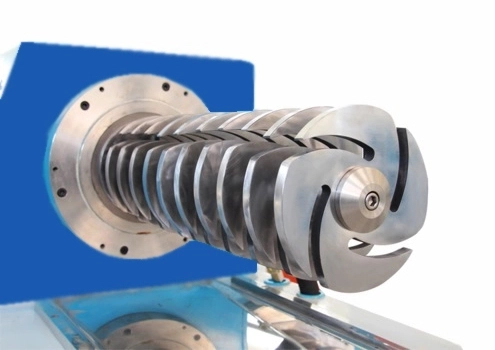
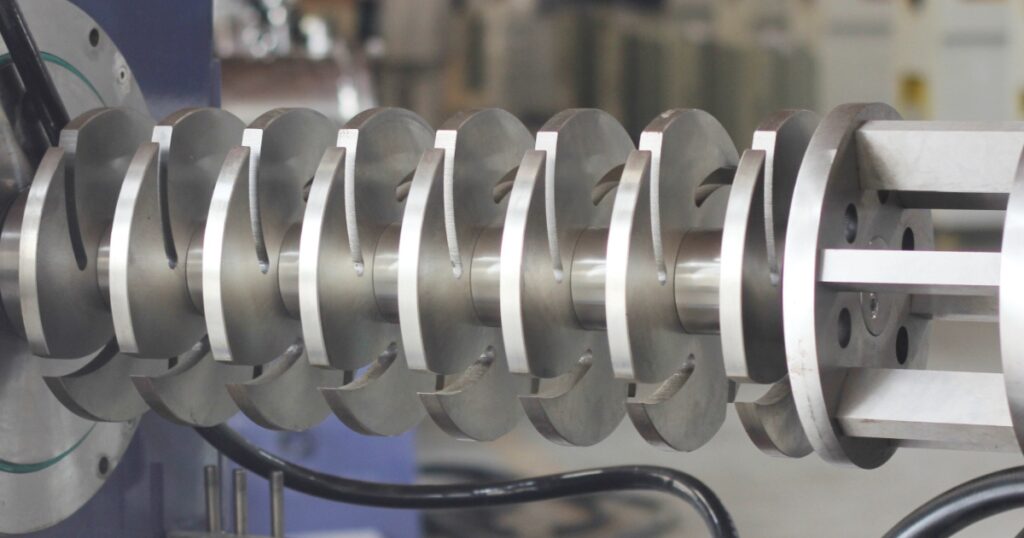
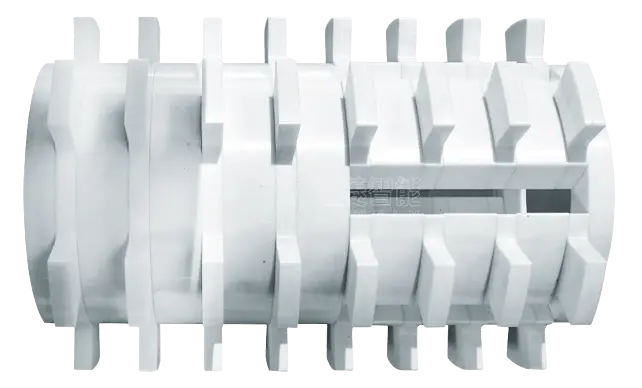
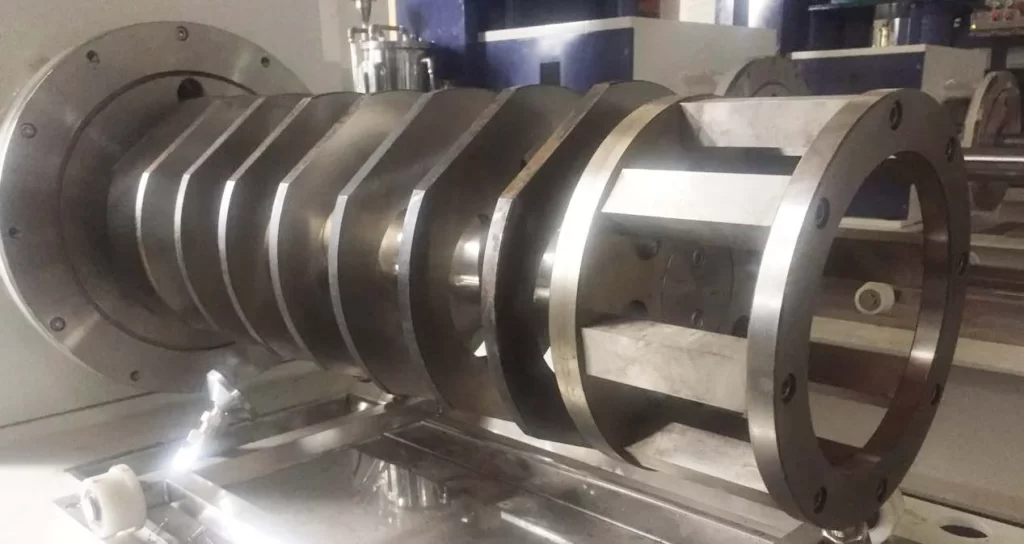
A horizontal shaft runs through the grinding chamber. Several round discs are fixed along that shaft. The discs can be flat, perforated or shaped. The chamber is long and narrow, with a length-to-diameter ratio of about 3 to 1. It is filled with grinding beads, and a cooling jacket wraps around it. At the outlet, a separator keeps the beads inside while the product flows out.
How Energy Reaches the Beads
Here is the key point. The discs do not hit the beads directly. Instead, the spinning discs speed up the liquid. Then the moving liquid drags the beads along with it. In plain words, the disc stirs the fluid, and the fluid stirs the beads. Supplier sources describe this as energy transfer through viscous drag and fluid friction. As a result, the impact forces on the beads are relatively small and gentle.
Typical Disc Mill Numbers
The table shows common supplier ranges for disc mills. Always check the exact figures with the maker of your machine.
| Item | Typical disc mill range (vendor data) |
|---|---|
| Chamber size | 5-500 L |
| Bead size | 0.8-2.0 mm |
| Tip speed | 8-14 m/s |
| Minimum particle size | About 1 µm |
| Cooling | Jacket cooling |
Where Disc Mills Shine
- Simple design: smooth discs are cheap and easy to make.
- Low upkeep: there are fewer hard-wearing parts to replace.
- High flow at standard fineness: they give very good throughput per kWh for 5-10 µm products.
- Gentle grinding: they make less heat, so they suit many solvent and water-based products.
Where Disc Mills Struggle
Disc mills depend on the thickness of the liquid. As the grind goes on, the pigment surface area grows, and the drag on the beads gets weaker. In addition, the long chamber needs a lot of beads. This large bead volume creates a strong filtering effect, and it pushes hard on the separator. Because of this, very small beads are hard to use. We explain that limit in detail in a later section.
If your product is a standard paint or ink, the disc agitator is often all you need. See our bead mill range to compare sizes and options.
How a Pin Agitator Bead Mill Works
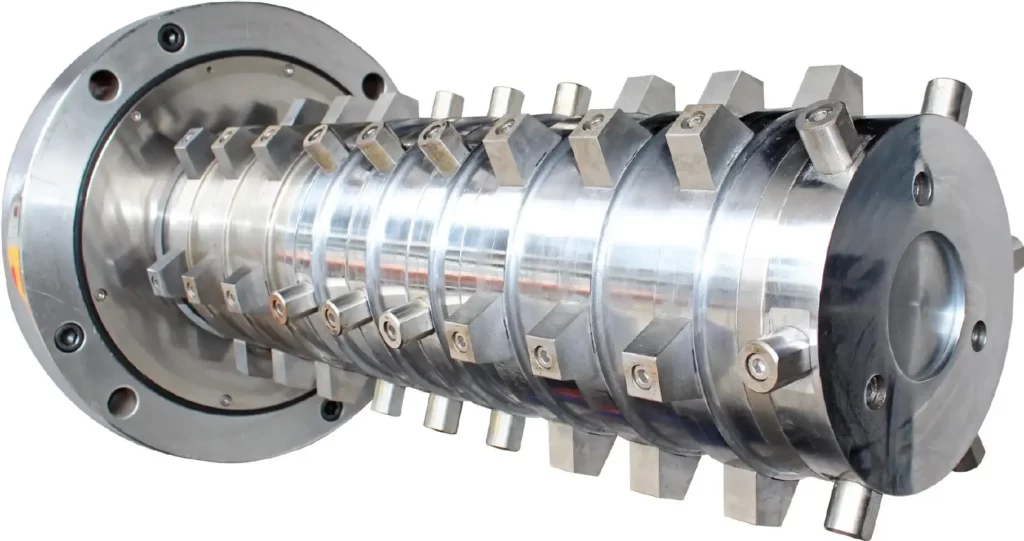
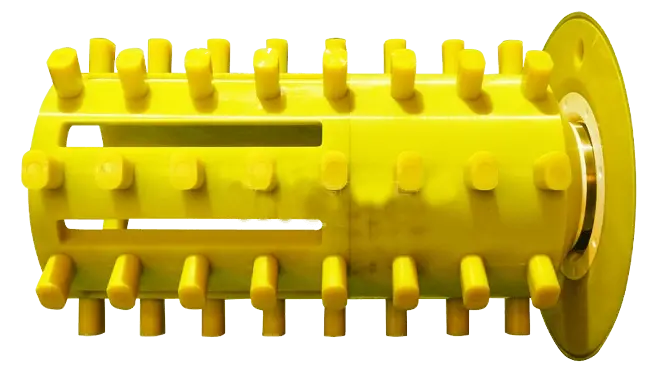
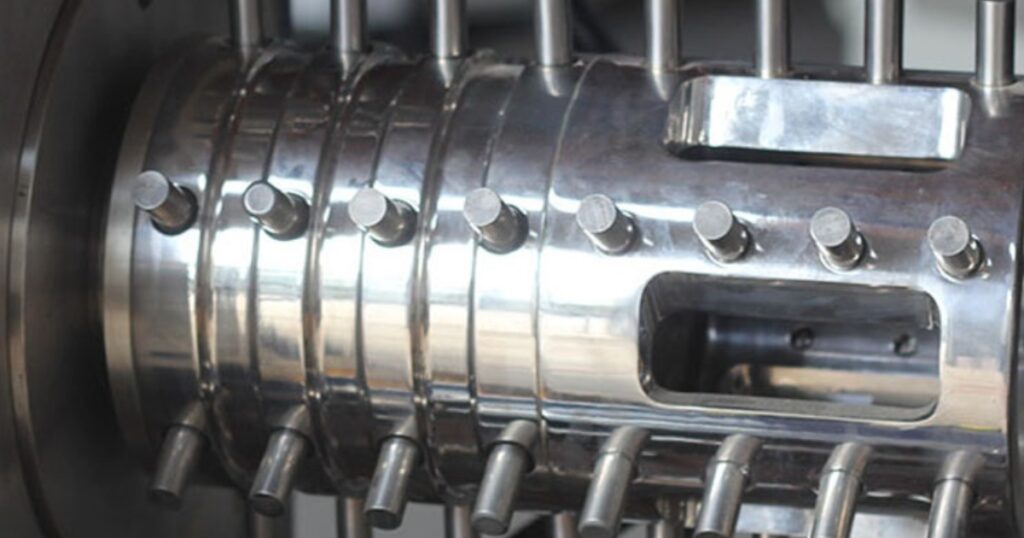
A pin agitator bead mill takes a different path. Instead of discs, its shaft carries many hardened pins. These pins hit the beads directly. As a result, the beads get a lot more energy, and the mill can reach much finer sizes.
The Main Parts of a Pin Agitator
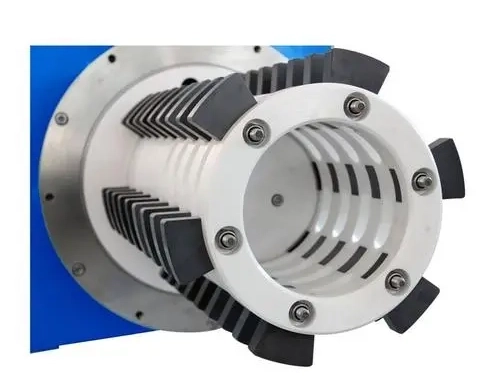
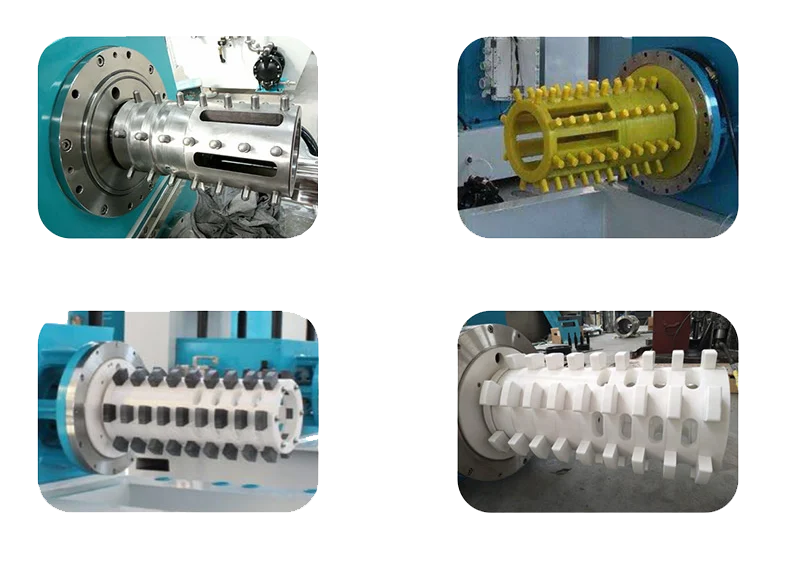
The shaft carries dense rows of pins, also called pegs. They are made from hard, wear-resistant materials such as tungsten carbide, ceramic, silicon carbide or polyurethane. The chamber is short and wide, with a length-to-diameter ratio of about 1.5 to 1, and the rotor has a larger diameter. In many pin mills, about two-thirds of the shaft length is used for bead separation. This design helps the mill run tiny beads without blocking the outlet.
How Energy Reaches the Beads
Here, the pins strike the beads right away. They do not need the liquid to carry the energy. So, the energy transfer stays steady even when the slurry gets thicker or when pigment surface area grows. Supplier sources describe the impact force of the pin structure as very large. As a result, the beads collide, rub and squeeze particles at high speed.
An ELE bead mill supplier page describes the idea in simple terms. The pins give the beads a large burst of kinetic energy, so the media collide and grind material quickly.
Paraphrased from the ELE pin-type bead mill product page (vendor source).
Typical Pin Mill Numbers
| Item | Typical pin mill range (vendor data) |
|---|---|
| Chamber size | 5-300 L |
| Bead size | 0.3-1.0 mm (micro beads of 0.1 mm and below in nano types) |
| Tip speed | 10-16 m/s |
| Minimum particle size | About 200 nm |
| Cooling | Jacket, plus an optional chiller |
For a well-known reference, NETZSCH’s pin-type Zeta system covers chamber sizes from 0.08 L (lab) to 400 L (production). It runs beads from 0.1 to 3 mm and reaches nanometer fineness.
Where Pin Mills Shine
- Finer grinding: they reach below 5 µm and down to about 200 nm.
- Narrow size range: the particle sizes stay very close together.
- Small beads: they run beads that discs cannot drive well.
- Thick, high-solid slurries: the direct impact keeps working as the slurry gets thicker.
Where Pin Mills Cost More
The extra energy has a price. First, the rotor needs precise machining, and the pins need hard materials. Second, more energy means more heat, so the mill needs stronger cooling. Third, the pins wear, so you must plan for replacement. Therefore, a pin mill costs more to buy and to run than a simple disc mill. If your target is coarse, this cost may not pay back.
If you need fine, even grinding, our pin and nano bead mills are built for it, with four-point cooling to keep the product steady.
The Core Difference: Viscous Drag vs Direct Mechanical Impact
In short:
A disc agitator speeds up the fluid, and the fluid speeds up the beads, so energy transfer depends on viscosity. A pin agitator hits the beads directly, so energy transfer depends mainly on rotor speed.
That one difference explains almost everything else in this guide.
An Easy Way to Picture It
Imagine a pool full of plastic balls. In the first case, you stir the water with a paddle, and the moving water pushes the balls. That is a disc mill. In the second case, you hit the balls directly with a bat. That is a pin mill. The bat gives each ball more speed, and it works the same way no matter how thick the water is.
Why Viscosity Matters in a Disc Mill
In a disc mill, the liquid does the carrying. So, the thickness of the liquid changes how well the energy moves. At the start, the slurry is thin, and the beads move well. As grinding goes on, however, the pigment surface area grows, and the drag on the beads becomes less effective. The mill slows down just when you need more energy for the finer particles.
Why Pins Keep Their Strength
In a pin mill, the pins hit the beads without the liquid acting as a middleman. Because of this, the energy transfer holds up even when viscosity and surface area change. In addition, the high tip speed presses the beads together by centrifugal force. This makes the gaps between the beads smaller, so the grind is tighter and the size range is narrower.
What This Means in Practice
| If you need… | The better fit | Why |
|---|---|---|
| Gentle grinding and low heat | Disc | Smaller impact forces and less friction heat |
| The lowest cost at standard fineness | Disc | Simple rotor and lower upkeep |
| Sub-5 µm fineness | Pin | Direct impact gives more energy |
| Very small beads | Pin | Pins can drive light beads that discs cannot |
| A narrow particle size range | Pin | Higher bead compression and tighter gaps |
| Stable grinding in thick, high-solid slurry | Pin | Energy does not depend on viscosity |
A Fair Warning
Even so, pin does not always mean better. Some supplier sources say a pin mill can do the work of a disc mill, but not the other way around. That is true for fineness. However, a disc mill is usually cheaper and cooler for coarse targets. So, match the rotor to the job and not to the hype. Next, we compare the two designs side by side in one master table.
Head-to-Head Comparison Table: Pin vs Disc Agitator Bead Mills
Now let us put the two rotor types side by side. The table below brings together the main points from engineering research and supplier data. Where numbers come from supplier brochures, they are typical ranges. So, always confirm exact figures with your machine maker.
The Master Table
| Characteristic | Disc agitator mill | Pin agitator mill |
|---|---|---|
| Energy transfer | Viscous drag and fluid friction | Direct mechanical pin impact |
| Chamber shape | Long and narrow (L/D about 3:1) | Short and wide (L/D about 1.5:1), with a larger rotor |
| Tip speed (vendor ranges) | 8-14 m/s | 10-16 m/s |
| Bead size (vendor ranges) | 0.8-2.0 mm; about 0.6 mm and above for most separators | 0.1-1.0 mm; 0.3-1.0 mm is standard |
| Typical target fineness | 5-10 µm (paint grade 10-15 µm) | Below 5 µm, down to about 200 nm |
| Minimum practical size | About 1 µm | About 200 nm; nano types go lower |
| Particle size range | Moderate | Very narrow |
| Bead compression | Changes with rotor speed and the disc edge area | Higher and more even; centrifugal compression |
| Separator | High bead volume gives high drag on the separator | Larger separation system; about two-thirds of the shaft |
| Heat | Lower at standard fineness | Higher; needs multi-zone cooling |
| Viscosity range | Low to medium | Medium to high; high solids |
| Cost and upkeep | Lower; simple machined discs | Higher; precise rotor and hard wear parts |
| Cost position | Cost-effective workhorse | Premium and nano-capable |
How to Read the Table
Start with the first row, because it explains the rest. Direct impact gives the pin mill more energy, so it reaches finer sizes. That extra energy also makes more heat and needs harder parts, so it costs more. In contrast, the disc mill is gentle and simple. Therefore, it wins on cost when your target is not very fine.
Three Things the Table Does Not Show
- Your own product: two slurries with the same fineness target can behave very differently, so a trial always beats a chart.
- Other designs: turbine and conical agitators sit between or beyond these two. Our sand mill manufacturer guide introduces them.
- Throughput per kWh: discs often win at standard fineness, but pin mills can win at finer targets. We show a real example in the energy case study below.
A Quick Rule of Thumb
If your target is 10 µm or coarser, start with a disc mill. If your target is under 5 µm, or if you need very small beads, start with a pin mill. For anything in between, compare cost per ton, not only price per machine. You can see how we build both types on our bead mill page.
Not Sure Whether a Pin or Disc Rotor Fits Your Product? Let Us Test Your Sample.
Reading about rotors is a good start, but your slurry is unique. At Z-MIXER, our Test and Development Center can run your own material before you buy. Furthermore, every machine is tested 3-4 times before it ships, and you get a one-year warranty (wear parts excluded) plus lifetime after-service.
- A rotor and bead recommendation based on your target size.
- A quote built around your real output and budget.
- Straight advice from a team that builds both disc and pin mills.
Fill in the form below, and we will reply with a clear plan and a quote.
Chamber Geometry and Tip Speed: L/D Ratio and Peripheral Velocity
Two numbers explain a lot about any bead mill: the length-to-diameter ratio and the tip speed. Together, they show how the energy is packed into the chamber and how hard the beads are driven.
Chamber Shape: Long and Narrow vs Short and Wide
The length-to-diameter ratio, or L/D, compares how long the chamber is to how wide it is. According to the 2004 CoatingsTech paper, horizontal disc mills have an L/D of about 3:1. High-energy pin mills, however, have an L/D of about 1.5:1. In other words, the disc mill is long and narrow, while the pin mill is short and wide.
| Feature | Disc mill | Pin mill |
|---|---|---|
| L/D ratio | About 3:1 | About 1.5:1 |
| Rotor diameter | Smaller | Larger |
| Share of shaft used to separate beads | Small | About two-thirds |
| Common nickname | Long and narrow | “Short and fat” |
Why the Short and Wide Design Works
A short, wide chamber squeezes the energy into a smaller space. Because of this, each bead gets more action. In addition, the larger rotor spins faster at its edge. The wider design also leaves room for a bigger separation system. As a result, the mill can pass more product through without clogging.
What Is Tip Speed?
Tip speed, also called peripheral velocity, is how fast the outer edge of the rotor moves. It is measured in meters per second (m/s). You can calculate it with a simple formula.
Tip speed formula
Tip speed (m/s) = π × rotor diameter (m) × revolutions per second
Example (our own calculation): a 0.20 m rotor at 1,000 rpm moves at about 10.5 m/s. A 0.25 m rotor at 1,100 rpm moves at about 14.4 m/s.
Typical Tip Speed Ranges
These ranges come from supplier data, so use them as a guide.
| Rotor type | Tip speed | Source |
|---|---|---|
| Disc (general) | 8-14 m/s | IDA Equipment |
| Disc (POLYC PZP series) | 11.3-14.0 m/s | POLYC |
| Pin (general) | 10-16 m/s | IDA Equipment |
| Pin (POLYC PZB series) | 12.0-16.0 m/s | POLYC |
| Turbo (for reference) | 12-16 m/s | IDA Equipment |
Why Higher Tip Speed Gives a Tighter Size Range
In a pin mill, a higher tip speed pushes the beads outward by centrifugal force. As a result, the beads press closer together, and the gaps between them get smaller. These smaller gaps trap only smaller particles. Therefore, the particle size range gets tighter and finer. The CoatingsTech paper makes this point clearly.
Do Not Just Turn Up the Speed
More speed also means more heat, more wear and more power. So, there is always a sweet spot. Choose a speed that matches your bead size and slurry, and then watch the temperature and the motor load. Finally, remember that tip speed is only one part of the picture. Bead size, bead density and fill ratio matter too, as we explain in our grinding bead selection guide.
Grinding Media Limits and Media Separation: Why Discs Struggle Below 0.6 mm
Small beads grind finer, but they are hard to drive and hard to hold inside the chamber. Here, the pin and disc designs differ the most. Two ideas are at work: the energy that reaches the beads, and the separator that keeps them in.
Typical Bead Sizes by Rotor
| Rotor | Typical bead size | Notes |
|---|---|---|
| Disc agitator | 0.8-2.0 mm (about 0.6 mm and above) | Standard separators are sized for 0.6 mm and above |
| Pin agitator | 0.3-1.0 mm standard; 0.1-0.5 mm micro beads | Dynamic separators allow micro beads |
| NETZSCH Zeta (pin type) | 0.1-3 mm | Lab to production scale (0.08-400 L) |
Reason 1: Not Enough Energy for Tiny Beads
To grind an ink to about 200 nm, you need very small beads, around 0.1 to 0.5 mm. These beads are very light. A disc moves them only through the fluid, and this drag does not give them enough energy. Pins, however, hit the beads directly. So, they can drive tiny beads much better.
Reason 2: The Separator Gets Blocked
A disc mill needs a lot of beads to fill its long chamber. This large bead volume creates a strong filtering effect. The flow then pushes the beads against the separator and raises the drag force. With very small beads, the screen can block, the pressure can rise and the mill can trip. Because of this, small beads are risky in a standard disc design.
What One Real Test Shows
The CoatingsTech paper ran a phthalo blue ink on both mill types, and both used 250 µm steel media. The disc mill needed three passes and 11.7 minutes of residence time. The paper also notes that disc separators are sized for 0.6 mm media and above. So, discs can run small beads, but only slowly and with a risk of blocking. In practice, plants choose a pin mill when small beads are the plan.
How Pin Mills Keep Micro Beads Inside
Pin mills often use a dynamic centrifugal separator. This is a hollow cage that spins and throws the beads outward, while the product leaves through the center. Because the beads are pushed away from the exit, they do not block it. In addition, the larger separation system lets more product flow through. As a result, the mill can run beads as small as 0.1 mm without a blocked screen.
Bead Compression: Even or Uneven?
In a disc mill, the bead compression depends on the rotor speed and on the area near the disc edge. So, it varies along the chamber. In a pin mill, the compression is higher and more even through the whole grinding zone. This evenness helps give a narrower size range.
Four Practical Rules for Media and Rotors
- Use discs with beads of about 0.8 mm and above.
- Use pin mills when your plan calls for beads below 0.6 mm.
- Keep every bead larger than about 2.5 to 3 times the separator opening.
- Pick the rotor first, then the bead size, then the bead material.
For the full logic on bead size, material and fill ratio, read our grinding bead selection guide.
Particle Size and Distribution: What Each Rotor Achieves
In the end, you buy a bead mill for the result. So, let us look at the particle sizes each rotor can reach, and at how tight the size range is.
Fineness: What Each Rotor Can Reach
| Measure | Disc agitator | Pin agitator |
|---|---|---|
| Practical target | 10-15 µm for paint; 5-10 µm for standard inks | Below 5 µm, down to about 200 nm |
| Minimum particle size | About 1 µm | About 200 nm (nano types with 0.05-0.1 mm beads go lower) |
| Particle size range | Moderate spread | Very narrow spread |
| Color strength | Baseline | Higher; the same opacity can need less pigment |
These figures come from supplier sources and from our own guidance. In our sand mill guide, we note that disc mills are the classic, competitive choice at roughly 10-15 µm. We also note that pin mills reach 1-2 µm and nano sizes with beads down to about 0.2 mm.
What Particle Size Range Means
A product does not contain particles of just one size. Instead, it has a spread of sizes. D50 is the middle size, where half the particles are smaller. D90 is the size below which 90% of the particles fall. A narrow range means the D50 and D90 are close together. For a coating or ink, this gives more even color, gloss and flow.
Why Pin Mills Give a Tighter Range
Pin mills press the beads together more strongly, and they press them more evenly. Therefore, the gaps between the beads are small and steady. Fewer large particles escape, so the top end of the range comes down. Supplier sources describe the pin mill range as extremely narrow, while the disc mill range is more moderate.
A supplier source from ELE explains the history in a simple way. The pin bead mill changed the old horizontal mill that could only grind to the micron level, and the root reason is the much higher energy input.
Paraphrased from the ELE pin-type bead mill product page (vendor source).
Why Color Strength Matters
Finer, more even pigments spread light better. So, the same color can be reached with less pigment. In addition, glossy finishes look smoother. For premium paints and inks, this gain can pay for the extra cost of a pin mill. For a basic wall paint, however, it may not.
Typical Fineness Targets by Product
| Product | Typical target | Likely rotor |
|---|---|---|
| Architectural paint and primer | 10-15 µm | Disc |
| Standard gravure and flexo ink | 5-10 µm | Disc |
| Automotive paint and high-chroma ink | Below 5 µm | Pin |
| Inkjet ink | Down to about 200 nm | Pin |
Is There a Limit?
Yes. In 2010, Catharina Knieke and colleagues described a “true grinding limit” in the lower nano range. Below a certain size, even high energy cannot break the particles any further. So, choose a rotor that matches a realistic target, and confirm it with a trial. Our engineers can run that trial with your own material.
Heat, Viscosity and Solids Handling: Which Rotor Copes Better?
Grinding turns electricity into heat, and it also changes how thick your slurry is. Both facts shape the choice between a pin agitator and a disc agitator. So, this section looks at heat first, and then at viscosity and solids.
Where the Heat Comes From
Every hit between a bead and a particle makes a little heat. At full load, about 85 to 95% of the motor’s input power ends up as heat in the product, according to a bead mill temperature guide from POLYC. A pin mill puts more energy into a smaller space, and its pins strike the beads directly. As a result, it makes more friction and more heat. At standard fineness of 5 to 10 µm, a disc mill makes less heat.
Cooling Needs by Rotor
| Item | Disc agitator mill | Pin agitator mill |
|---|---|---|
| Heat at standard fineness | Lower | Higher |
| Typical cooling (vendor data) | Cooling jacket | Cooling jacket, plus an optional chiller |
| Extra cooling features | Usually not needed | Multi-zone jackets and cooling paths inside the rotor shaft |
| Best for heat-sensitive products | Standard fineness | Nano fineness, with a cooled shaft |
What Too Much Heat Does to Your Product
- It makes the slurry thinner or thicker, so the grind becomes uneven.
- It can break down heat-sensitive resins and binders.
- It can shift the color of some pigments.
- It speeds up the wear of beads and seals.
- It can push solvent-based products toward unsafe temperatures.
Because of this, plan your cooling before you plan your speed. Our horizontal mills use four-point cooling at the feed line, the jacketed chamber, the end cover and the mechanical seal. So, heat leaves from four places, and the product stays steadier. See more on our bead mill page.
Viscosity: Thin, Medium and Thick Slurries
Viscosity is how thick a liquid feels. In a disc mill, the liquid carries the energy, so the thickness changes the result. At the start, the slurry is often thin, and the beads move well. As grinding proceeds, the pigment surface area grows, and the drag on the beads gets less effective. In a pin mill, the pins hit the beads directly, so the energy transfer stays steady. Supplier sources say pin mills suit products with high viscosity, high solids and high fineness needs, in continuous or circulation operation.
Solids Content
High solids mean a thick, heavy slurry. This is common in battery slurries, agrochemical suspensions and some pigment pastes. A pin mill copes better here, because its direct impact does not rely on the liquid. A disc mill works well when solids are moderate and the viscosity is low to medium. If your slurry is very thick, a pre-dispersion step can help before the bead mill. Our sand mill guide shows where that step fits.
Quick Guide: Heat, Viscosity and Solids
| Your slurry | Better rotor | Reason |
|---|---|---|
| Thin to medium viscosity, moderate solids | Disc | Drag works well, and heat stays low |
| High viscosity or high solids | Pin | Direct impact does not depend on the liquid |
| Heat-sensitive product at standard fineness | Disc | Lower heat at 5-10 µm |
| Heat-sensitive product at nano fineness | Pin with a cooled shaft | Needs high energy and strong cooling together |
Energy Efficiency Case Study: Phthalo Blue Ink (256 vs 406 kWh/t)
Here is one of the clearest real comparisons between the two rotors. It comes from the 2004 JCT CoatingsTech paper by H. W. Way. The same ink went through both machines, and the paper recorded how much energy each one used.
The Test Setup
Case study: phthalo blue ink
- Same slurry in both mills, with 250 µm steel media in both.
- Disc mill: three passes, 11.7 minutes of total residence time, 406 kWh per ton.
- Pin mill: circulation grinding, 4.3 minutes of residence time, 256 kWh per ton.
- Result: about 37% less energy per ton for the pin mill, and a finer product.
The paper does not give a numeric particle size for this test. It states that the disc mill “does not produce as fine a particle size.”
What Is Specific Energy?
Specific energy is the energy used per ton of product. Engineers write it as the total mill power, minus the idle power, divided by the throughput in tons per hour. For example, if a mill draws 60 kW, idles at 15 kW and handles 0.5 tons per hour, its specific energy is (60 − 15) ÷ 0.5 = 90 kWh per ton. This is our own simple illustration. In the paper, the pin mill’s 256 kWh per ton and the disc mill’s 406 kWh per ton were measured on the same ink.
Why Did the Pin Mill Win?
The paper does not give one exact reason for this test. However, it makes a general point. The pin mill has a larger separation system, so much higher flow rates are possible, and this gives higher grinding efficiency and higher energy efficiency. In addition, the pin mill’s direct impact keeps working as the ink gets finer, while the disc mill’s drag loses strength. Together, these ideas fit the numbers.
The CoatingsTech paper ties the two ideas together. Because the pin mill has a larger separation system, much more product can flow through it, and this gives higher grinding efficiency and higher energy efficiency.
Paraphrased from H. W. Way, “Grinding and Dispersing Nanoparticles,” JCT CoatingsTech, January 2004.
What This Case Does Not Prove
Be careful with one test. It used steel media and one ink. Also, the paper is from 2004, and mills have improved since then. So, do not assume a 37% saving for your product. Instead, use the case as a reason to compare cost per ton, not only machine price. If your target is fine, a pin mill may pay back its higher price through lower energy and faster output.
How to Test This for Your Own Product
- Grind the same batch on a disc mill and on a pin mill at your target fineness.
- Record the power draw, the idle power and the throughput for each run.
- Calculate specific energy in kWh per ton for both.
- Measure D50 and D90 after each run.
- Compare cost per ton, including beads, energy and time.
Our Test and Development Center can run this comparison with your own material, so you see real numbers before you buy.
Want Real Energy Numbers for Your Own Ink or Coating? Run a Trial With Us.
One published case showed a 37% energy gap between two rotors. Your product may behave differently, so we test it for you. At Z-MIXER, our Test and Development Center runs your material on our mills, and our team reports the fineness and energy data. Every machine also ships after 3-4 factory tests.
- A side-by-side comparison on your sample.
- Clear numbers for fineness, throughput and power.
- A quote based on cost per ton, not only machine price.
Send us your product details below, and we will arrange your trial.
CapEx, Maintenance and Wear Parts: What Each Rotor Really Costs
Price matters, but it is only part of the story. A mill’s cost includes the purchase, the wear parts, the upkeep and the energy. Pin and disc agitators differ on every one of these points.
Purchase Cost: Why Pin Rotors Cost More
A smooth disc is fairly cheap to machine. A pin rotor is different. It needs high-precision machining to fit the hardened pins and to stay balanced at speeds up to 16 m/s. Because of this, the rotor costs more. Supplier sources describe five-axis CNC machining for pin rotors. In short, you pay for the precision.
Wear Parts: Harder Materials for Pins
Pins hit the beads directly, so ordinary steel wears fast. As a result, pin mills use harder materials such as tungsten carbide, high-nickel alloys, silicon carbide ceramics or polyurethane. These cost more, but they last longer. Z-MIXER offers chamber and rotor materials in alloy steel, silicon carbide, zirconia, polyurethane and tungsten carbide, so we can match the wear part to your product.
Cost Comparison Table
| Cost item | Disc agitator mill | Pin agitator mill |
|---|---|---|
| Purchase price | Lower | Higher |
| Rotor manufacture | Simple machined discs | Precision machining with hardened pins |
| Wear part materials | Standard options | Tungsten carbide, ceramic, SiC or PU |
| Maintenance cost | Lower | Higher, but longer-lasting parts |
| Energy cost per ton at standard fineness | Often lowest | Higher |
| Energy cost per ton at fine targets | Higher (more passes) | Can be lower (see the case study) |
Scale Reference From a Well-Known Maker
For scale, NETZSCH lists its Discus disc grinding systems with outputs from 5 kg/h up to 14,000 kg/h and motors from 3 to 400 kW, according to DirectIndustry. Its pin-type Zeta system covers chambers from 0.08 L to 400 L. So, both designs scale from the lab to full production. Our own disc mills range from 0.6 L up to 8,000 L.
Total Cost of Ownership
To compare fairly, use cost per ton. Add the bead cost, the wear parts, the energy, the downtime and any rework. A cheap disc mill that needs three passes can cost more per ton than a pin mill that needs one. On the other hand, a pin mill is wasteful if your target is coarse. For bead cost logic, see the cost section in our grinding bead selection guide.
2026 Market Snapshot
Market reports measure different things, so their numbers do not match. Read the scope column before you quote any figure. We have not re-opened these reports, so please check them before you publish a number.
| Market (scope) | Size | Forecast | CAGR | Source |
|---|---|---|---|---|
| High-viscosity bead mills (pin, disc and turbine types) | $735M (2025); $773M (2026) | $1,073M by 2032 | 5.6% (2026-2032) | Market Research Center |
| Agitator bead mills (all types) | $1.8B (2026) | $3.15B by 2035 | 6.40% | MarkWide Research |
| Global bead mills (alternative estimate) | $1.877B (2025) | $2.591B by 2032 | 4.7% | Global Research (Japan) |
Even with different scopes, the direction is clear. MarkWide Research reports that horizontal agitator mills hold the largest product-type share. It also says that continuous setups are replacing batch systems in battery-cathode work. In addition, paints hold the largest application share, while chemicals are growing fastest. In other words, both rotor types have a healthy market.
Applications: When to Choose Disc, When to Choose Pin
Now let us turn the theory into choices. The table gives a quick answer for common products. After that, short notes explain each case.
Quick Scenario Table
| If your product is… | Choose | Because |
|---|---|---|
| Architectural paint, primer, base coat (10-15 µm) | Disc | Lowest cost per ton; the classic workhorse |
| Standard gravure or flexo ink (5-10 µm) | Disc | High throughput per kWh |
| Automotive paint or high-chroma ink (under 5 µm) | Pin | Narrow size range and maximum color strength |
| Inkjet ink (down to about 200 nm) | Pin | Micro beads and dynamic separation |
| Carbon black, CMY pigments, ferrite, zeolite, ceramic raw materials | Pin | Hard, clumped materials need impact energy |
| Agrochemical SC and high-viscosity slurries | Pin | High solids and high viscosity |
| Battery cathode (LFP, NCM) and other nano materials | Pin or turbo | Nano fineness and tight contamination control |
| Pharma nano-suspensions | Pin or turbo | Targets below 200 nm |

Paints and Coatings
For wall paint, primers and base coats, a disc agitator is usually enough. It reaches 10-15 µm at a low cost. For premium automotive paint, however, a pin mill gives the tighter size range and the higher color strength. Learn more about the full paint process in our sand mill grinding workflow guide.
Printing Inks
Standard gravure and flexo inks at 5-10 µm suit a disc mill. Finer and more demanding inks suit a pin mill. See our rotogravure ink equipment guide for more.
Inkjet Inks
Inkjet nozzles are tiny, so large particles can block them. Because of this, inkjet inks need sizes down to about 200 nm. A pin or nano mill with micro beads and a dynamic separator is the right tool. Our inkjet ink equipment guide explains the full line.
Hard Pigments and Ceramics
Carbon black, ferrite, zeolite and ceramic raw materials are hard and tend to clump. A pin mill gives the impact energy to break them. This is why many plants choose pin mills for these jobs.
Agrochemicals, Batteries and Pharma
Agrochemical suspension concentrates are thick and high in solids, so pin designs and our high-flux ZSF mill, which runs beads down to 0.3 mm, are a good fit. Battery slurries and pharma nano-suspensions need nano fineness and clean grinding. For these, choose a pin or nano mill with the right wear materials. Explore the full range on our bead mill page.
Not Sure Where You Fit?
If your product is not on the list, send us a sample. We will test it and suggest a rotor that fits.
Decision Flowchart: Disc or Pin Agitator?
You now know how both rotors work. So, let us turn that knowledge into a simple decision path. Follow the steps in order, and stop at the first step that clearly fits your product.
The Seven-Step Checklist
| Step | Question | If yes, choose |
|---|---|---|
| 1 | Is your target 10 µm or coarser, with standard paint or ink viscosity? | Disc |
| 2 | Is your target 5-10 µm, and do you want the highest throughput per kWh? | Disc |
| 3 | Is your target below 5 µm, or below 2 µm with a narrow size range? | Pin |
| 4 | Do you plan to use beads below 0.6 mm? | Pin (discs cannot drive them well) |
| 5 | Is your slurry high in viscosity or high in solids? | Pin |
| 6 | Is it a heat-sensitive, solvent-based product at nano fineness? | Pin with a cooled shaft |
| 7 | Is your budget tight, and your grade coarse? | Disc |
How to Use the Checklist
First, check steps 4, 5 and 6, because they are the hard limits. If any of them is a yes, a pin mill is the safer choice. Next, look at steps 1, 2 and 7. If they all fit, a disc mill will probably serve you well and cost less. Finally, if you land in between, compare cost per ton for both and run a trial.
Worked Example 1: Wall Paint
A paint plant makes interior wall paint. The target is about 12 µm, the slurry is of medium viscosity, and cost matters most. Steps 4, 5 and 6 are all a no. Steps 1 and 7 are a yes. So, a disc agitator mill fits. It reaches the target at the lowest cost per ton, and it needs little upkeep.
Worked Example 2: Inkjet Ink
An ink maker needs inkjet ink with sizes down to about 200 nm. The ink is solvent-based and sensitive to heat. Steps 3, 4 and 6 are all a yes. So, a pin or nano agitator mill with a cooled shaft and 0.1-0.3 mm beads fits. It costs more, but it is the only practical way to reach the target and avoid nozzle blocking.
Common Mistakes to Avoid
- Buying pin power for a coarse product: you pay more and gain very little.
- Buying a disc mill for nano targets: you will need many passes, or you will not reach the target at all.
- Ignoring cooling: a pin mill at high speed needs real cooling, not just a jacket.
- Choosing by price only: compare cost per ton, including beads, energy and rework.
- Skipping the trial: a short test with your own slurry beats any chart.
What to Gather Before You Decide
Write down your target D50 and D90, your slurry viscosity and solids, your daily output, your heat limit and your bead size plan. With these five facts, any engineer can recommend a rotor quickly. For the full machine view, read our bead mill selection guide.
Ready to Pick the Right Rotor? Send Us Your Target and We Will Recommend a Mill.
A short list of facts is all we need to get started: your product, your target size and your daily output. Then our engineers suggest a disc or pin design, test your sample and explain the result in plain words. In addition, you get a one-year warranty (wear parts excluded), lifetime after-service and thousands of spare parts in stock.
- A clear rotor recommendation for your product.
- A sample test in our Test and Development Center.
- A quote built around your real output and budget.
Complete the form below, and our team will get back to you with a clear plan.
FAQ: People Also Ask About Pin and Disc Agitator Bead Mills
Here are quick, clear answers to the questions buyers ask most about pin agitator bead mills and disc agitator bead mills.
What is the difference between a pin and disc bead mill?
A disc agitator speeds up the fluid, and the fluid then drags the beads, so energy depends on viscosity. A pin agitator hits the beads directly with hardened pins. Disc mills typically use 0.8-2.0 mm beads and reach 5-10 µm. Pin mills use 0.1-1.0 mm beads and reach below 5 µm, down to about 200 nm.
What is a pin type sand mill?
A pin type sand mill is a horizontal bead mill whose rotor carries rows of hardened pins instead of discs. The pins strike the grinding beads directly and create high energy density. It suits high-viscosity, high-solid products that need sub-micron or nano fineness, in continuous or circulation operation.
Which bead mill is best for paint?
A disc type mill is usually best for general paint. It is the classic, cost-effective choice for architectural and industrial paints at about 10-15 µm, and it gives high throughput per kWh at standard fineness. For premium automotive paint under 5 µm, a pin mill gives a tighter size range.
Which bead mill is best for nano grinding?
Pin and turbo type mills are best for nano grinding. They use short, wide chambers, micro beads of about 0.05-0.3 mm, dynamic separators and tip speeds up to 16 m/s. They can reach below 200 nm. A standard disc mill cannot drive very small beads well.
Why can’t disc mills use small grinding beads well?
There are two reasons. First, discs move beads only through fluid drag, which gives tiny beads too little energy. Second, a disc mill holds a large volume of beads, which creates a strong filtering effect and can block a standard separator. Discs can run small beads in a test, but slowly and with risk.
What tip speed do bead mills run at?
Supplier data shows disc mills at about 8-14 m/s and pin mills at about 10-16 m/s. Turbo or nano mills run at about 12-16 m/s. Tip speed equals pi times rotor diameter times revolutions per second. Higher speed gives more energy, but it also adds heat and wear.
Are pin mills more expensive than disc mills?
Yes, to buy and to maintain. Pin rotors need precise machining and hard wear parts such as tungsten carbide, silicon carbide or polyurethane. However, they can cost less per ton at fine targets. In a published phthalo blue test, the pin mill used 256 kWh/t against 406 kWh/t for the disc mill.
Which is better for high-viscosity products?
A pin mill is usually better. Its pins pass energy to the beads directly, so the grind does not depend on how thick the liquid is. Supplier sources say pin mills suit high-viscosity, high-solid products. A disc mill works best with low to medium viscosity.
What is a turbo bead mill?
A turbo bead mill is a third rotor type. It uses turbine-shaped or centrifugal agitators at about 12-16 m/s with beads of about 0.05-0.3 mm. It has very high energy density, and it is used for battery materials, nano materials, pharma and electronics below 200 nm.
Can a pin mill do everything a disc mill can?
For fineness, mostly yes. Some suppliers say a pin mill can do the disc mill’s work, but not the other way around. However, a disc mill is gentler, cooler and cheaper for coarse targets. So, a pin mill is often more than you need for basic paint.
Which mill gives a narrower particle size range?
The pin mill does. Its higher tip speed presses the beads together by centrifugal force, which tightens the gaps and gives a tighter, finer size range. Suppliers describe pin mill distributions as very narrow, while disc mill distributions are more moderate.
What is the L/D ratio of a bead mill chamber?
The L/D ratio compares chamber length to diameter. Horizontal disc mills have an L/D of about 3:1, which is long and narrow. High-energy pin mills have about 1.5:1, which is short and wide. Pin mills also use about two-thirds of the shaft length for bead separation.
Conclusion: Match the Rotor to Your Product, Then Prove It With a Trial
Pin and disc agitator bead mills are not rivals. They are tools for different jobs. When you match the rotor to your target size, your slurry and your budget, you save money and protect your product quality.
The Key Points in One Place
- Disc agitator: energy comes through fluid drag. It is simple, gentle and low-cost, and it suits 5-15 µm products.
- Pin agitator: pins hit the beads directly. It reaches below 5 µm, down to about 200 nm, with a narrow size range.
- Geometry: discs have an L/D of about 3:1, and pin mills about 1.5:1.
- Beads: use discs with beads of about 0.8 mm and above, and pin mills for beads below 0.6 mm.
- Heat and cost: pin mills make more heat and cost more, so they need strong cooling and hard wear parts.
- Energy: in one published ink test, the pin mill used 256 kWh/t against 406 kWh/t for the disc mill.
- Decision: use the seven-step checklist, compare cost per ton and run a trial.
Why a Trial Beats a Table
Charts and rules get you close. However, your slurry, your target and your plant are unique. So, always test your own material. Measure the particle size, the temperature and the energy per ton. Then choose the rotor that gives the best cost per ton, not only the lowest price.
How Z-MIXER Can Help
Z-MIXER TECH has built mixing and grinding machines in Wuxi, China since 2008. Our horizontal bead mill range includes disc, pin, turbine, high-flux and nano designs, so we can recommend the one that fits you. Every machine is tested 3-4 times before it ships. You also get a one-year warranty (wear parts excluded), lifetime after-service and thousands of spare parts in stock.
If you are ready to grind finer, faster and cleaner, take the next step now. Send us your product, your target size and your daily output. Our engineers will reply with a clear plan and a quote.
Ready to Choose the Right Bead Mill Rotor? Request Your Quote Today.
Do not leave your results to chance. Tell us what you grind and how fine it must be. We will recommend a disc, pin or nano design, test your sample and match it to a Z-MIXER bead mill that fits your plant and your budget.
- A rotor and bead mill recommendation based on your sample.
- A quote built around your real output and cost per ton.
- Warranty, spare parts and lifetime after-service from the maker.
Complete the form below, and our team will reply with a clear plan.
Further Reading and Sources
- JCT CoatingsTech: Grinding and Dispersing Nanoparticles (H. W. Way, January 2004)
- NETZSCH: Grinding System Zeta (pin-type agitator bead mill)
- DirectIndustry: NETZSCH horizontal mills (Discus series specifications)
- Turkchem: A Different Perspective on Selection of Wet Grinding Equipment
- POLYC: Bead Mill Temperature Control
- Market Research Center via ZDNet Japan: High-viscosity bead mill market
- MarkWide Research: Agitator bead mill market
- Global Research (Japan): Global bead mills market report